Thursday, December 17, 2015
Me and Elizabeth Gilbert (well, sort of) on Creativity


Monday, September 14, 2015
A fast track to honesty

I'm actually pretty chuffed to have been asked to do something non-motherhood related. I've had the chance to be part of so many great panel discussions about creativity and motherhood lately, but I'm rarely asked to write or talk about other subjects, so it's a chance for me to break out!
On the creativity/mothering front, though - there's a few things I want to share.
I took part in a conversation as part of the Wheeler Centre's "F Word" series, along with Maxine Beneba Clarke, Liz Shield and Zakia Baig - all about feminism and parenting. If you're interested, you can watch it here.
You've probably heard about musician Amanda Palmer's response to a fan (and financial backer) who wrote to her concerned that Amanda's output is set to dwindle - and risk becoming mediocre - now that she is pregnant:
When you have this baby, either him/her/it will suffer, or your career will suffer. ...
Are your patrons paying for new music, or are they paying for a new baby?
I had mixed feelings about Amanda's response - she's working with her own set of assumptions about mothers...:
So no small wonder that as I approached my mid-thirties I entered a conflicted baby conundrum. If I had kids, would I turn into a boring, irrelevant, ignorable artist? Would I suddenly start writing songs about balance and shit? Would I have a sudden, terrifying, interest in the LUTE?
...But both the original letter and Amanda's response show the prevalence of those cliches - and the associated fears - about the risk motherhood poses to an artist's work and identity. Read her full response here.

Ha!
Yes, there are moments of great tenderness and joy. But for me, these exist as the flipside to the incredible angst and vulnerability that comes with raising children. Not true for everyone, I know. But as I told Amanda, motherhood has been the most confronting, raw, edgy, passionate state I have known. It exposes you to yourself like little else can. Yes, it can be a barrier to making art. But, if you can find a way to keep creating, it can also give your art an extraordinary edge.
If Amanda Palmer's doubting fan is really that worried, she should check out this video about Suzannah Espie's latest album - and listen to her stunning album, Mother's Not Feeling Herself Today. As Suzannah says, motherhood has "been a fast track to some pretty major honesty".
Saturday, August 22, 2015
Stopping for a cupcake in a hurricane
 |
| Me, trying to draw with a baby Griffin on my hip. |
Since then, I've produced a second edition and been asked to speak on the subject of creatvity and motherhood for countless events, festival panels, radio interviews, articles, blogs and videos.
Sometimes -- regularly -- I lose my sense of what I want to say. In talking repeatedly on the topic, I have to re-find the core of my feelings over and over again, to make sure I'm speaking with fresh words and not just parroting what I've said before.
That gets particularly challenging when life has become so full of other responsibilities that I'm getting almost no writing done, bar the odd line scratched onto the back of an envelope while on the train to work, so that I literally forget what it means to be holding tight to that need to create.
There is sometimes a kind of liberation in this. A sense that it's been so long, I can give up on any loaded expectations of success and just rediscover writing for its own sake. As a form of play. Of describing the world to myself. Of clarifying my thoughts... But even that requires occasional access to a pen, a notebook and a spare hour or so! Too long away from the page and I start struggling to find meaning. In anything.
Tomorrow, when I speak at the Melbourne Writers Festival, I will be drawing on this exquisite essay by writer Sarah Menkedick, which has singlehandedly plunged me back into a full recognition of why needed to write The Divided Heart in the first place.
Not that anything has changed. Family life feels no less demanding and chaotic now as when my children were babies -- though perhaps the physical demands have been replaced by more emotional and practical ones. As Menkedick describes it, in trying to write, I still "might as well be stopping for a
cupcake in a hurricane".
She describes perfectly the contradictory state imposed by mothering: the struggle to justify and to defend this ephemeral desire -- a need to write (or draw, or sing...) -- in the face of the most solid and significant job of all: keeping a "small, vulnerable human alive". And the way that forces us to stake a claim to the worth of art. But more than that -- far more confrontingly (for mothers, still working to shrug off the heavy baggage of guilt and self-sacrifice that is our historical inheritance) -- the worth of our art, at the very least to ourselves.
As Menkedick says:
It requires a terrible and terrific arrogance for me to claim three hours to hash out a half-coherent treatise on waiting and the gestation periods of walruses: an arrogance not only in the immediate domain of my family but in a larger, universal sense, to imagine that fitting life into language matters when I have now lived the reality of birth and the pressing need of a hot little mouth.
The preciousness of that time, the fact that it is so contested and fraught with the weight of what is not being done with it, have forced my hand: I have to admit that I believe in art. Not as an abstract concept, and not as tangible and real salvation, but as a way of being.
Read her full essay over at Vela, an online mag of women's writing.
 And if you haven't discovered 'The New Normal' podcast yet, then you're missing out!
I had a great time chatting to Emma and Tess in Emma's kitchen (complete with dishwasher noises) -- all about combining creativity and motherhood, overcoming guilt and learning to love football!
You can listen to it here.
Monday, July 20, 2015
The conversation that never ends: art and parenting

Fortunately for me, the theme of my book means I'm almost always sharing the stage with at least one and sometimes many more generous and inspiring women, who make it feel like I'm having a chat over a cup of tea - albeit a very intelligent one.
The audiences are always excellent too. There's usually a few mothers pacing the floor up the back, babe in arms, and some sweet baby noises - which is guaranteed to make me feel happy.
I'm sure that will definitely be the case with the next few events I'm involved in, so please come along and join the conversation. The Q&A sessions are always my favourite part!
Melbourne Writers Festival: Creativity & Motherhood
August 22, 4.00-5.00pm
with Tracee Hutchison and Jessica Rowe
Northcote Town Hall Main Hall, High Street, Northcote
Creative Spark: Art and Parenting - October 8 (TBC), 6.30-7.30pm
with artist Tai Snaith, writer Lorelei Vashti and arts industry expert Robin Penty
Thornbury Theatre, 859 High Street, Thornbury
Tuesday, June 23, 2015
Claudia Karvan and me on the airwaves this Sunday
 |
| Actors Claudia Karvan and Alex Cook |
But if you're up anyway, you might like to tune into Radio National to hear Claudia Karvan and I talking to Jonathan Green on Sunday Extra at 8.45am.
You should also be able to listen to it later here.
Tuesday, June 9, 2015
Divided Hearts at the Willy Lit Fest
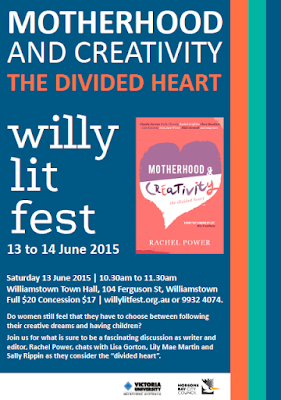
This weekend, I will be hosting a panel at the Williamstown Literary Festival featuring poet Lisa Gorton, writer and illustrator Sally Rippin, and artist Lily Mae Martin.
If you're in Melbourne we'd love to see a room full of friendly faces. This will be a great chance to ask three of Motherhood & Creativity's contributors any questions you may have about how they navigate a life of art and family.
Our session is on Saturday June 13 at 10.30-11.30am. Book here.
If you're in Melbourne we'd love to see a room full of friendly faces. This will be a great chance to ask three of Motherhood & Creativity's contributors any questions you may have about how they navigate a life of art and family.
Our session is on Saturday June 13 at 10.30-11.30am. Book here.

Saturday, June 6, 2015
Vale Joan Kirner

When I was asked to write an article about her legacy for younger feminists, I felt ashamed by my own ignorance about what that legacy might be. My overriding memory of Kirner was her having a red-hot go at covering Joan Jett's "I Love Rock 'n' Roll" on ABC TV's The Late Show.
It wasn't until I began speaking to those I work amongst in the union movement, that I realised what a profound impact she'd had on women on the Left. Every person I spoke to had an anecdote about having a cup of tea at Joan's house, or just sharing an elevator with her, where she would ask them about their lives -- as well as the ins and outs of the current political landscape -- and let them know that she was there for them. Not only that, Joan remembered everything they said next time she saw them, including the names of their children.
ACTU president Ged Kearney told me that she doesn't know of anyone more revered or loved by those who came in her wake than Joan Kirner. She was tirelessly giving in the support and mentoring she offered other women, and she fundentally believed that the stuff of women's lives gave them what it takes to be leaders.
Former ACT chief minister Katy Gallagher told me that when Joan Kirner met her daughter they discussed tooth fairies. "So she bought her a book about tooth fairies and wrote a little message inside saying Abby, who she called Princess, was lucky to have me as her mother."
Just the kind of message all women need to hear.
Vale Joan Kirner. A woman like no other.
You can read my article in Today's Age newspaper (page 30) or online here.
Subscribe to:
Posts (Atom)